By Palm Beach &Broward Mugshots
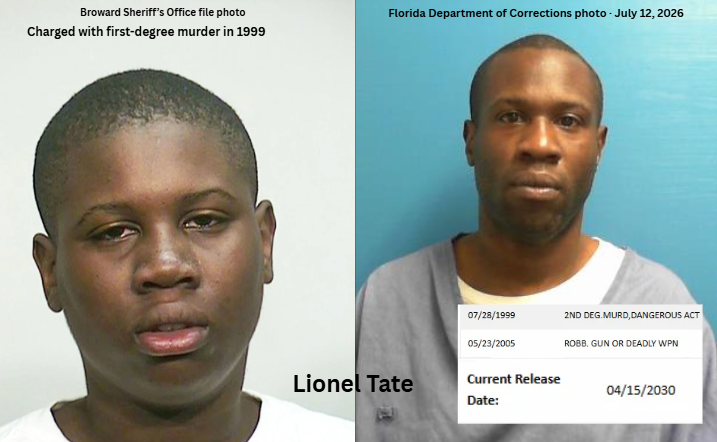
The death of six-year-old Tiffany Eunick, a controversial adult prosecution and a rejected plea agreement turned Lionel Tate’s case into one of the most debated chapters in Broward County’s criminal-justice history. More than 25 years later, Tate remains in Florida state prison with a projected release date in 2031.
In July 1999, Lionel Tate was a 12-year-old in Broward County. Within two years, he would become nationally known as the youngest person in modern American history sentenced to life in prison without the possibility of parole.
At the center of the case was six-year-old Tiffany Eunick.
Tiffany died after being left downstairs with Tate while Tate’s mother, Kathleen Grossett-Tate, was babysitting her. Tate’s defense would later contend that Tiffany was accidentally injured while he imitated professional wrestling moves.
The physical evidence told a far more disturbing story.
According to the Florida appellate decision that later overturned Tate’s conviction, Tiffany suffered approximately 35 injuries. They included a fractured skull, injuries to her brain and internal organs, more than 20 bruises, a fractured rib and damage to her liver.
The appellate court noted that none of the experts—including those called by the defense—believed Tiffany’s injuries were consistent with play fighting or that they were accidentally inflicted. Read the appellate opinion.
A 12-year-old charged as an adult
Tiffany died on July 28, 1999. A Broward County grand jury subsequently indicted Tate on a charge of first-degree murder, placing the 12-year-old into Florida’s adult criminal-court system.
Before trial, prosecutors offered Tate an agreement that would have reduced the charge to second-degree murder. The proposed sentence reportedly included three years in a juvenile facility, followed by one year of house arrest, 10 years of probation and 1,000 hours of community service.
Tate’s defense rejected the offer and took the case to trial.
That decision would become one of the most consequential elements of the entire case.
The defense maintained that Tate did not intend to kill Tiffany and argued that her death resulted from wrestling moves copied from television. Prosecutors countered that the number and severity of her injuries could not reasonably be explained as innocent roughhousing.
In January 2001, a Broward County jury convicted Tate of first-degree murder.
Because Florida law mandated the sentence, the judge had little discretion. On March 9, 2001, Tate was sentenced to life in prison without the possibility of parole.
He was 14 years old when the sentence was imposed.
A sentence that ignited a national debate
The punishment immediately generated debate well beyond Broward County.
Some observers focused on the extraordinary severity of Tiffany’s injuries and argued that her age and suffering could not be minimized simply because the person responsible was also a child.
Others questioned whether a 12-year-old possessed the maturity and legal understanding necessary to be prosecuted as an adult and face permanent imprisonment.
Juvenile-justice advocates also questioned whether Tate understood the plea agreement that could have resulted in his release after several years. The case became a national example in debates over competency, childhood development and the prosecution of young defendants in adult court.
Even individuals involved in the prosecution later expressed discomfort with the outcome. The case appeared to expose a gap between Florida’s juvenile system and adult sentencing laws: the available juvenile punishment was considered inadequate by some, while mandatory life imprisonment was considered excessive by others.
Tiffany’s death, however, remained the reason the legal proceedings existed. The debate over Tate’s age and sentence did not change the fact that a six-year-old girl suffered fatal injuries while in a home where she should have been safe.
The conviction is overturned
Tate appealed his conviction and sentence.
On December 10, 2003, Florida’s Fourth District Court of Appeal reversed the conviction. The court did not find Tate innocent or conclude that Tiffany’s death was accidental.
Instead, the appellate court identified a constitutional problem with the proceedings: serious questions about Tate’s competency had not been properly evaluated before trial.
The court ruled that the failure to conduct an appropriate competency evaluation violated Tate’s due-process rights. The decision gave prosecutors the option of trying him again.
With his original conviction overturned, Tate was again offered a resolution similar to the one rejected before trial.
In January 2004, Tate pleaded guilty to second-degree murder. He was released after spending approximately three years in custody and began serving a sentence that included house arrest, probation, counseling and community service.
For a short period, the case appeared to have reached a conclusion that provided Tate with another opportunity outside prison.
It did not last.
The pizza-delivery robbery case
On May 23, 2005, Tate was arrested following an encounter involving a pizza-delivery driver in Broward County.
Investigators accused Tate of confronting the driver with a handgn after an order was delivered to an apartment. The driver reportedly dropped the pizzas and fled before returning and identifying Tate. Authorities did not recover the alleged firearm.
The arrest created two separate legal problems for Tate.
First, he faced new criminal charges arising from the alleged robbery. Second, possessing a firearm and engaging in new criminal conduct violated the probation imposed in the Tiffany Eunick case.
In May 2006, Broward Circuit Judge Joel Lazarus sentenced Tate to 30 years in prison for violating probation by possessing a firearm. The same judge had imposed Tate’s original life sentence five years earlier.
The Associated Press reported that the judge told Tate he had exhausted the opportunities previously extended to him. Contemporary sentencing coverage.
Tate continued contesting the separate robbery prosecution. In February 2008, he entered a no-contest plea and received a 10-year sentence that ran concurrently with the existing 30-year sentence.
Because the sentences were concurrent, the additional 10 years did not simply attach to the end of the 30-year term.
Where is Lionel Tate now?
Tate remains in the custody of the Florida Department of Corrections.
Florida corrections information reproduced from his inmate record has listed his current projected release date as April 28, 2031. Earlier reporting similarly placed his scheduled release in 2031. ABA Journal’s 2008 case update.
A projected release date is not an unconditional promise of release. The Florida Department of Corrections can recalculate dates based on sentence structure, credit, gain time, disciplinary decisions, court orders and other factors. The date should therefore be described as projected and verified again before publication through the state’s official inmate search using Tate’s name or Florida DOC number L24475.
If the current projection remains unchanged, Tate will have spent approximately 25 years in state custody on the probation-violation sentence by the time he is released. That period followed the years he had already spent confined during the original murder prosecution.
A case Broward County never forgot
The Lionel Tate case has never fit neatly into a single narrative.
It is the story of Tiffany Eunick, a six-year-old child who sustained catastrophic injuries and lost her life.
It is also the story of a 12-year-old prosecuted in a system designed primarily for adults, a plea agreement rejected before trial, a mandatory life sentence and an appellate reversal based on unresolved questions about competency.
Finally, it is the story of what happened after Tate received another chance. Within approximately 16 months of his release, he was arrested in a new case and eventually returned to prison under a 30-year sentence.
The legal system overturned Tate’s original conviction because constitutional protections had not been followed—not because the courts determined that Tiffany’s death was an accident.
More than a quarter-century later, the questions raised by the case remain unsettled: How should the justice system punish a child responsible for an extraordinarily violent act? How young is too young for adult court? And what responsibility do attorneys and judges have to ensure that a child truly understands a plea offer, a trial and the consequences of rejecting an agreement?
Those questions made the case nationally significant.
For Broward County, however, the story begins and ends with the loss of Tiffany Eunick.
Lionel Tate case timeline
| Date | Development |
|---|---|
| July 28, 1999 | Six-year-old Tiffany Eunick suffers fatal injuries while alone with 12-year-old Lionel Tate in a Broward County home. |
| August 1999 | A Broward grand jury indicts Tate on a first-degree murder charge. |
| Before trial | Tate’s defense rejects an agreement calling for three years in juvenile custody, one year of house arrest and 10 years of probation. |
| January 2001 | A Broward County jury convicts Tate of first-degree murder. |
| March 9, 2001 | Tate receives the mandatory sentence of life in prison without parole. |
| December 10, 2003 | The Fourth District Court of Appeal reverses the conviction because Tate’s competency was not properly evaluated. |
| January 2004 | Tate pleads guilty to second-degree murder and is released under a sentence that includes house arrest and probation. |
| May 23, 2005 | Tate is arrested following the alleged armed robbery of a pizza-delivery driver. |
| May 18, 2006 | Tate receives a 30-year sentence for violating probation by possessing a firearm. |
| October 24, 2007 | The appellate court upholds the probation-violation sentence. |
| February 19, 2008 | Tate enters a no-contest plea in the robbery case and receives a concurrent 10-year sentence. |
| April 28, 2031 | Current projected Florida DOC release date, subject to recalculation or change. |
All individuals are presumed innocent unless proven guilty in a court of law.
Comments are moderated. Text only. No photos, videos, links, addresses, phone numbers, victim information, witness names, threats, harassment, racial slurs, or unverified accusations. All individuals are presumed innocent unless proven guilty in a court of law. Your email must be verified before your comment can be reviewed. For safety and moderation, comment submissions may include your name, email, IP address, browser/device information, and comment activity.