By Palm Beach and Broward Mugshots LLC
PENSACOLA, Fla. — Ladarius “LD” Clardy was 18 years old, a former standout quarterback at Pine Forest High School and a college football player at Kennesaw State University when his life was cut short in a barrage of gunfire.
Investigators said Clardy was not the intended target.
Nearly five years later, one man is serving life in prison for his murder. A second man—his brother—was also convicted and sentenced to life, but that conviction was overturned after an appeals court determined that investigators repeatedly ignored his requests for an attorney.
Without the statements obtained during that interrogation, prosecutors ultimately dismissed the second brother’s charges.
More than 50 rounds fired
During the early morning hours of July 1, 2021, Clardy and 19-year-old Eric Young were traveling toward Young’s home when another vehicle pulled alongside them.
The occupants opened fire.
Clardy’s vehicle left the road and crashed into a ravine at approximately 1 a.m. Authorities said the car had more than 50 bullet holes.
Clardy had been struck 14 times and died from his injuries. Young was also shot and left in critical condition, but he survived.
Investigators later concluded that the attack was connected to a planned klling and that Clardy had been mistaken for the intended target.
The murder stunned Pensacola’s athletic community. Clardy had established himself as a talented quarterback at Pine Forest High School before continuing his education and football career at Kennesaw State University in Georgia.
His father, Ladaron Clardy, later became a public voice against gun violence, calling for a safer community and an end to the cycle of retaliatory kllings.
Five men initially charged
The investigation eventually resulted in charges against five men:
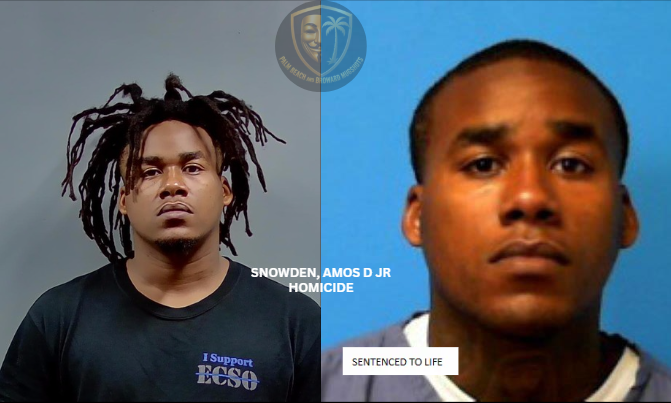
- Amos Dehontiquan Snowden
- Da’Quavion Keamos Snowden
- Kobie Lashun Jenkins Jr.
- Timothy Donaill Knight Jr.
- Terrell Taquez Parker
Amos and Da’Quavion Snowden are brothers. Neither man is related to Ladarius Clardy.
Charges against Jenkins, Knight and Parker were dismissed in February 2023 after prosecutors determined that the available evidence did not meet the standard required to continue with their cases.
The Snowden brothers proceeded to separate trials on allegations that they participated in the attack that killed Clardy and wounded Young.
Da’Quavion Snowden convicted first
Da’Quavion Snowden went to trial in July 2023.
Jurors heard recordings and received transcripts from a lengthy police interrogation conducted after Snowden’s arrest. During those interviews, Snowden made statements about the vehicle used in the attack and his alleged involvement.
The jury convicted him of first-degree premeditated murder and attempted first-degree premeditated murder. He was sentenced to life in prison without parole.
At the time, the conviction appeared to bring prosecutors one step closer to resolving the case.
Amos Snowden sentenced to life
Amos Snowden went to trial in January 2024.Prosecutors accused him of participating in the murder of Clardy and the attempted murder of Young. A jury found Amos guilty of first-degree premeditated murder and attempted first-degree premeditated murder.
The murder conviction carried a mandatory life sentence.
Amos Snowden remains imprisoned for Clardy’s murder.
The Miranda-rights appeal
Da’Quavion Snowden appealed his convictions to Florida’s First District Court of Appeal.
His attorneys argued that the trial judge should have excluded statements Snowden made during approximately 13 hours of questioning because he repeatedly requested an attorney, but investigators continued speaking with him.
According to the appellate opinion, Snowden was arrested following the execution of a search warrant at the registered address associated with the license plate on the vehicle allegedly used in the attack.
He was placed shirtless and without shoes in an interview room, where he was chained to a table. After vomiting on the floor and being temporarily removed while the room was cleaned, Snowden asked whether he could speak with his lawyer.
Approximately an hour after substantive questioning began, Snowden again said he needed an attorney because he did not know what to tell investigators.
Several minutes later, he made a third request: “I need a lawyer.”
The court found all three requests unequivocal.
Despite those requests, officers continued discussing the case with Snowden. Some conversations occurred during smoke breaks and were recorded. Investigators later returned to the interrogation room, questioned him further and revisited his earlier statements.
Snowden ultimately said he had not been one of the shooters but had been forced to drive the vehicle.
Before trial, his attorneys asked the judge to suppress the statements. The trial court denied that request, concluding that Snowden’s initial references to an attorney were unclear and that he later reinitiated contact with investigators.
The recorded statements were then presented to the jury that convicted him.
Appeals court reverses the conviction
The First District Court of Appeal disagreed with the trial judge.
In its October 8, 2025, substituted opinion, the appellate court concluded that Snowden had clearly invoked his right to counsel at the beginning of the interrogation and that questioning should have stopped.
The judges described Snowden as facing “relentless pressure” during the 13-hour process. They ruled that his later decision to continue speaking resulted from improper coercive tactics and did not cure investigators’ earlier failure to honor his requests.
Because the statements played a significant role at trial, the court could not find that their admission was harmless.
The court reversed Da’Quavion Snowden’s murder and attempted-murder convictions and returned the case to Escambia County for a new trial. Florida First District Court of Appeal
The decision did not declare Snowden innocent. It found that evidence used against him had been obtained in violation of the protections governing custodial interrogation.
Charges dismissed rather than retried
After the reversal, prosecutors initially had the option of trying Da’Quavion Snowden again without the excluded statements.
That trial never occurred.
In December 2025, the state dismissed the murder and attempted-murder charges. Court filings indicated that without Snowden’s statements, prosecutors could no longer prove the allegations beyond a reasonable doubt.
Snowden was released from the Escambia County Jail on December 5, 2025.
Escambia County Sheriff Chip Simmons publicly disagreed with the appellate court’s conclusion but acknowledged that the ruling had to be respected.
The dismissal was not an acquittal following a second trial. It represented the state’s determination that the remaining admissible evidence was insufficient to meet its burden of proof. WEAR-TV, NorthEscambia
An uneven legal ending
The prosecution ended with sharply different outcomes:
- Amos Snowden remains convicted and is serving life in prison.
- Da’Quavion Snowden’s convictions and life sentence were overturned, and his charges were dismissed.
- Charges against Jenkins, Knight and Parker were dismissed before trial.
- No charges were filed against Clardy or Young; investigators described them as victims of a mistaken-identity attack.
The legal aftermath became unusually complicated, but the central fact remains unchanged: Ladarius Clardy, an 18-year-old athlete with a future ahead of him, was klled after more than 50 rounds were fired into his vehicle.
His passenger survived. One conviction remains. Four other defendants are no longer being prosecuted.
For Clardy’s family and the Pensacola community, the case remains a lasting example of how mistaken identity and gun violence took the life of a young man who was never supposed to be the target.
Father and son serving life
Florida Department of Corrections records indicate that Amos Snowden Jr. is not the first member of his immediate family to receive a life sentence.
His father, Amos D. Snowden, has been incarcerated since 2009 following convictions in an unrelated Escambia County case. State prison records list two life sentences for sexual-battery offenses, along with a 25-year sentence for aggravated battery with a deadly weapon and a five-year sentence for false imprisonment.
The older Snowden’s case has no connection to the murder of Ladarius Clardy.
Amos Snowden Jr. is now serving his own life sentence for Clardy’s murder. His separate appeal was rejected by the First District Court of Appeal in June 2025, leaving his conviction intact. His brother, Da’Quavion Snowden, received a different outcome when his convictions were overturned over ignored requests for counsel and prosecutors later dismissed his charges.
That creates a remarkable family contrast: a father and son serving life, while the other son’s life sentence was overturned because of Miranda violations.
Comments are moderated. Text only. No photos, videos, links, addresses, phone numbers, victim information, witness names, threats, harassment, racial slurs, or unverified accusations. All individuals are presumed innocent unless proven guilty in a court of law. Your email must be verified before your comment can be reviewed. For safety and moderation, comment submissions may include your name, email, IP address, browser/device information, and comment activity.